
As the application session is coming to its end, I see and hear from many people asking about profile evaluation. I can understand the confusion as I faced them myself probably two years ago. There was much confusion as to where should I apply? How many colleges to apply? Should I email the Professor? etc.
Here I am going to answer the most critical question of all. How should one select the universities to apply to? Now keep in mind that some of the things here are general and applies to all engineering and non-engineering streams.
The most important thing to know here is that many times when people apply, they have a specific area interest in mind. However, it is not necessary that you will end up with a group working in the same field. Here’s how it works.
Once you get an admission offer, the research group you will end up working in often not decided. It becomes clear at the end of the first semester. So when you reach the university, the first semester is spent mostly in coursework. During the end of the first semester, potential advisors will give a presentation in which they will talk about their work and whether or not they will be taking any new Ph.D. students. It depends on their research grant. If they already have a research grant, they will have a clear idea of whether or not they will take a new Ph.D. student. This is the period when most of the decisions on research grants are declared. So either they will explicitly declare they want to take new Ph.D. student or might hold their decisions till they hear back from funding agencies. This brings me to the most important point to look when you are going to apply for Ph.D., Research Grants.
I always recommend new Ph.D. applicants to ensure that their potential advisor has research grants. It is a good way of increasing your admission chances. Suppose you are a new student interested in working on electrochemical or catalysis related research. Now you have shortlisted few universities and finally, you are confused between two universities X and Y. University X is more popular and highly ranked, but the Professors in both universities have the same impact and research citations. Now if you want to apply to only one out of them, a better option would be to look at their group website for research grants. A typical example would be like the image below.

I would suggest to go with some with higher research funding and apply to that particular university as it has a higher chance of taking students.
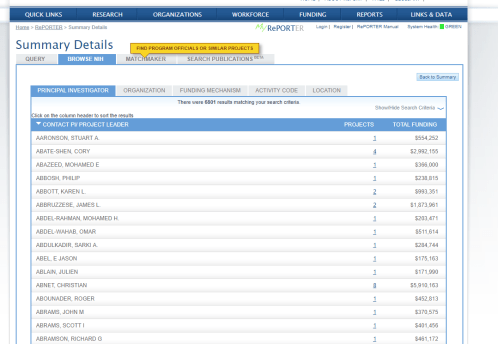
Apart from the existing funding, I would suggest exploring websites like NSF, DOE, and NIH for current funding results and probably select university with higher funding. Let’s take an example here, suppose you are a biomedical/biochemical student and want to do research on cancer treatment. Here is how you can narrow your selection criteria
- Go to NIH RePORTER
- click on browse NIH tab
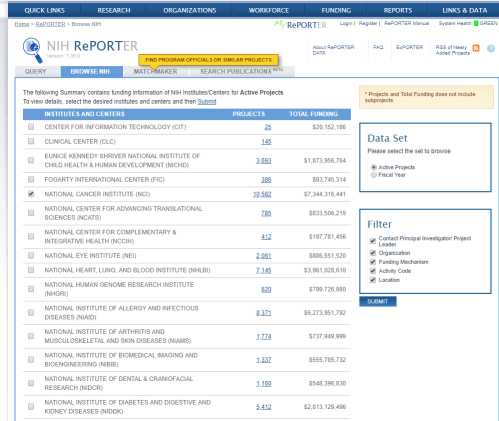
- Click enter and look for your potential advisor and their funding
For people working in a field supported by NSF and DOE projects, you can go to their websites and look for department-specific resources. One such example is shown below.
https://www.fastlane.nsf.gov/servlet/A6RecentWeeks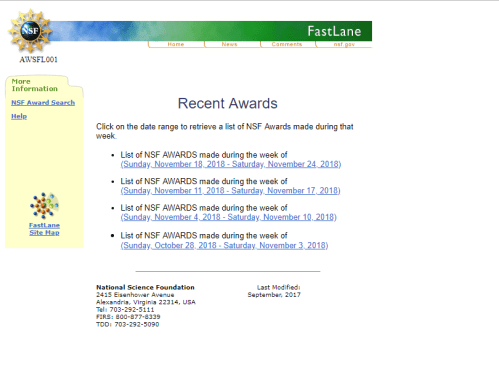
Note: I also recommend writing to Ph.D. students in a particular research group and asking about groups funding scenario and whether they are looking to take new students in the coming application cycle or not. This has a higher chance of response than writing to a prospective professor and asking directly about it.
All the best in your application cycle and let me know if you have any questions. Also, subscribe to my blog to be updated about new posts. Thanks.
 Studycentrals
One thought on “Application Guide for future Ph.D. students”