

The decision to take the GRE (Graduate Record Examination) exam when it is optional for college admissions depends on several factors. Here are some considerations to help you make an informed decision:
- Check Admission Policies:
- Review the admission policies of the specific colleges or programs you are interested in. Some institutions may state that the GRE is optional, but it’s crucial to understand whether not taking it will have any impact on your application.
- List of some of the colleges that have made GRE optional for graduate studies
- Here are a few examples of schools that, at the time of my last update, had either made the GRE optional or had specific programs with this policy:
- Harvard University – Some departments within Harvard’s Graduate School of Arts and Sciences have made the GRE optional.
- MIT (Massachusetts Institute of Technology) – Some programs at MIT do not require the GRE.
- Stanford University – Some departments within Stanford’s School of Humanities and Sciences have made the GRE optional.
- University of Chicago – The Division of the Social Sciences at the University of Chicago made the GRE optional for the 2020-2021 and 2021-2022 admissions cycles. “Not Required/Optional: Applicants who do not submit a GRE are not penalized during the review process. We encourage applicants to GRE-optional programs to only provide a score if they feel it reflects well on their abilities.”
- Columbia University – Some programs within the Graduate School of Arts and Sciences at Columbia have made the GRE optional.
- Brown University – Several departments at Brown University’s Graduate School have made the GRE optional.
- New York University (NYU) – Some graduate programs at NYU have made the GRE optional.
- University of California, Berkeley – Some programs at UC Berkeley’s Graduate Division have made the GRE optional.
- University of Michigan, Ann Arbor – Some programs at the University of Michigan have made the GRE optional.
- Johns Hopkins University – The Bloomberg School of Public Health at Johns Hopkins has made the GRE optional for certain programs.
- Keep in mind that policies can change, and specific departments within a university may have different requirements. Always check the official admissions information provided by the institution or contact the admissions office for the most accurate and up-to-date information.
- Strength of Your Application:
- If your academic and professional background is strong, and you have other compelling aspects of your application (such as a high GPA, relevant work experience, strong letters of recommendation, etc.), you might not need to take the GRE.
- Program Requirements:
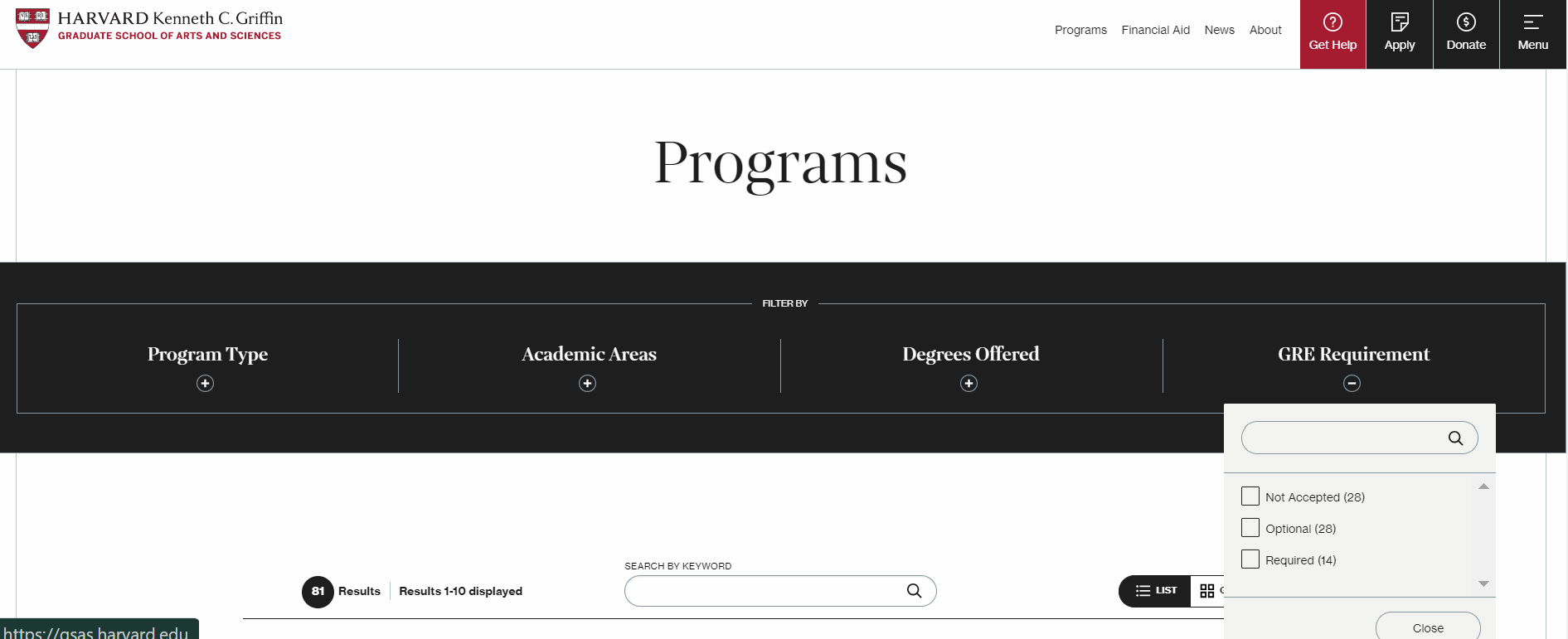
- Consider the specific requirements of the program you are applying to. Some programs may place more emphasis on GRE scores, especially if they are in fields where standardized testing is traditionally more important. For example, the screen grab from Harvard admission portal shows there are programs where GRE is not accepted, few have GRE as optional, whereas for few programs it is required. So it is always encouraged to check the university websites for the grad courses admission requirements.
- Competitive Nature of the Program:
- If the program is highly competitive and many applicants will likely have GRE scores, taking the exam could give you an additional opportunity to stand out.
- Personal Strengths and Weaknesses:
- Assess your own strengths and weaknesses. If standardized tests are not your strong suit and you believe your application would be stronger without GRE scores, it might be reasonable to skip the exam.
- Application Cost and Effort:
- Consider the cost and effort involved in preparing for and taking the GRE. If you have the time and resources to perform well, it might be worth it. However, if preparing for the GRE will detract significantly from other aspects of your application, you may want to weigh the benefits.
- Consult with Admissions Advisors:
- If possible, reach out to admissions advisors or representatives from the programs you are interested in. They can provide guidance on whether taking the GRE is advisable based on the specifics of their admissions process.
In summary, the decision to take the GRE when it’s optional depends on the individual circumstances and the requirements of the programs you are applying to. It’s essential to carefully evaluate all aspects of your application and consider the specific policies of the institutions you are interested in before making a decision.
 Studycentrals