“The GradCafe Admissions Forum” – a podcast that covers topics related to graduate school admissions, including tips for writing personal statements, preparing for the GRE, and choosing the right program.
“Graduate School Admissions with Dr. Alexis” – a podcast that focuses on providing advice and insight into the graduate school admissions process. Topics covered include how to select the right program, tips for writing successful application essays, and strategies for obtaining funding.
“The Accepted Admissions Podcast” – a podcast that covers a wide range of topics related to graduate school admissions, including tips for choosing a program, advice on writing personal statements, and strategies for preparing for interviews.
“Grad School Insiders” – a podcast that covers various topics related to graduate school, including admissions, funding, and life as a graduate student. It also includes interviews with graduate students and professionals in the field.
“The Grad School Podcast” – a podcast that covers a wide range of topics related to graduate school, including admissions, funding, and tips for success in graduate school.
“Graduate School Admissions Podcast” – a podcast that provides advice and guidance on navigating the graduate school admissions process, including tips for selecting the right program, writing effective personal statements, and preparing for interviews.
“The Grad School Planners” – a podcast that provides tips and advice on how to plan for graduate school, including tips on selecting the right program, how to fund your education, and how to prepare for the application process.
“The Graduate Corner” – a podcast that covers various aspects of graduate school, including admissions, funding, and life as a graduate student. It also includes interviews with graduate students and professionals in the field.
“The Graduates” – a podcast that provides tips and advice on how to navigate graduate school, including tips on selecting the right program, how to fund your education, and how to prepare for the application process.
“The PhD Career Stories Podcast” – a podcast that provides advice and inspiration for graduate students and early-career researchers, including tips on how to apply for graduate school, how to navigate the job market, and how to build a successful career in academia or industry.
TOEFL stands for Test of English as a Foreign Language. It is a standardized test designed to measure the English language proficiency of non-native speakers. The test is used by universities, colleges, and other institutions in English-speaking countries to assess the language skills of students whose native language is not English. The test assesses the ability to understand North American English and is divided into four sections: reading, listening, speaking, and writing. The test is available in two formats: internet-based test (iBT) and paper-based test (PBT). The scores are valid for two years and the test is offered several times a year.
The test is administered by the Educational Testing Service (ETS) and is required for admission to many colleges and universities in the United States and other English-speaking countries. The test is divided into four sections: Reading, Listening, Speaking, and Writing, each section is designed to measure different aspects of English language proficiency. The test is scored on a scale of 0 to 120, with higher scores indicating a greater level of proficiency.
It is a standardized test that measures the English language proficiency of non-native speakers. The test is commonly required for admission to universities and colleges in English-speaking countries, as well as for certain professional certifications and visa applications. The TOEFL test has four sections: Reading, Listening, Speaking and Writing. Each section is designed to assess a specific aspect of a candidate’s English language skills. The test is administered in an internet-based format (iBT) and a paper-based format (PBT) and is available in many countries around the world. The score range is from 0-120 and the total duration of the test is approximately 4 hours.
How to Register for TOEFL?
There are several ways to register for the TOEFL:
Online: The easiest way to register for the TOEFL is through the official TOEFL website (www.toefl.org). You can create an account, choose a test date and location, and pay the registration fee online using a credit or debit card.
Phone: You can also register for the TOEFL by calling the ETS Registration Service. You will need to provide your personal information and pay the registration fee over the phone using a credit or debit card.
Mail: If you prefer to register by mail, you can download the registration form from the official TOEFL website and mail it along with your payment to the ETS Registration Service.
In Person: You can also register for the TOEFL in person at certain locations, such as test centers or educational institutions.
It is important to register early to secure your preferred test date and location. Also note that there are deadlines for registration, and late registration may result in additional fees.
How much does TOEFL cost?
The cost of the TOEFL varies depending on the country where you take the test, but in general the cost ranges between $160 – $250. In some countries the test fee may be higher.
It’s important to note that the test fee is non-refundable and non-transferable, so you should make sure you are able to take the test on the date you have selected before you register. Also, if you need to reschedule your test date or change your test center, there may be additional fees.
It is also worth checking for discounts, promotions or scholarships that might be available for the test fee, for example for students or for certain groups of people. Additionally, some universities or organizations offer fee waivers for the TOEFL.
Can I take TOEFL at home?
The main difference between the TOEFL Home Edition and the TOEFL iBT test that is taken at a test center is the testing environment.
The TOEFL Home Edition is an internet-based test that can be taken from the comfort of your own home. It is designed for candidates who are unable to take the test at a test center due to test center closures or other restrictions related to COVID-19 pandemic. The test is proctored by a human proctor using AI technology, which monitors the test-taker’s computer and surroundings during the test.
The TOEFL iBT test that is taken at a test center is a traditional test format that was used before the outbreak of the pandemic. It is an internet-based test that is administered in a controlled testing environment at an ETS-authorized test center. The test is proctored by a human proctor.
Both versions of the test include the same four sections: Reading, Listening, Speaking and Writing and the scores are same. However, the home edition test has some differences in the way the test is administered, such as the use of a remote proctor and the need for a secure testing environment at home.
How to prepare for TOEFL?
There are many resources available for TOEFL preparation, including:
Official TOEFL guidebook: This book is published by the Educational Testing Service (ETS), the organization that administers the TOEFL. It contains information about the test format, scoring, and question types, as well as sample questions and test-taking strategies.
TOEFL practice tests: These are available online and in print, and provide an opportunity to become familiar with the test format and question types.
TOEFL prep courses: Many educational institutions and private companies offer TOEFL prep courses, which can provide in-depth instruction and practice opportunities.
TOEFL apps and websites: There are many TOEFL apps and websites available that provide practice questions and test-taking strategies.
English language classes: If you are still working on your English language skills, taking an English class can be beneficial.
It’s recommended to use a combination of these resources for best results.
Click here to check out one of the best self-paced TOEFL preparation course.
The best way to prepare for the SAT is to practice with sample questions and take full-length practice tests. This will help familiarize you with the test format and question types. Additionally, you can focus on studying specific areas where you need improvement, such as grammar or math concepts. It is also a good idea to take an SAT prep course or hire a tutor for additional support. Another good way is to study from the Official SAT Study Guide which is published by College Board (the makers of the SAT) and is considered as the best study material for the exam.
There are several ways to prepare for the SAT:
Use official SAT study materials: The College Board, the organization that administers the SAT, offers a variety of official study materials, including a practice test book and online resources.
Take a prep course: Many organizations offer SAT prep courses that provide intensive test preparation through in-person classes, online classes, or self-paced study programs.
Practice, practice, practice: The more practice tests you take, the more comfortable you will become with the test format and the types of questions that will be asked.
Focus on your weaknesses: Identify the areas where you need the most improvement and focus your study efforts there.
Get a good night’s sleep and eat a healthy breakfast on test day: You’ll perform your best if you’re well-rested and have a good meal in your stomach.
Time management is key: Time management is critical on the SAT. Learn to pace yourself so you can complete the test in the time allotted.
Seek help from a tutor if needed: If you are having trouble with specific topics or question types, consider working with a tutor who can provide personalized instruction and feedback.
Self-paced online learning is a flexible and convenient way to prepare for the SAT. There are many online resources available, such as practice tests, video lessons, and interactive exercises, that can help you to study and review the material covered on the test. Some popular online resources for self-paced SAT preparation include Khan Academy, CollegeBoard, and Kaplan. Many of these resources provide personalized study plans, progress tracking, and interactive tools to help you study and practice. Additionally, you can find many test-taking strategies and tips from the test-taking experts. It is important to find a resource that aligns with your learning style and create a study schedule that works for you.
Click here to check Magoosh, one of the best self-paced SAT preparation resource.
The Graduate Record Examinations (GRE) is a standardized test that is required for many graduate programs in the United States and other countries. The test is designed to measure a student’s verbal reasoning, quantitative reasoning, and analytical writing skills, and is used by graduate schools to help determine a student’s readiness for graduate-level coursework. The test is offered in both computer-based and paper-based formats, and scores are valid for five years. The GRE is a widely accepted test, and many graduate programs in diverse fields like Business, Science, Technology, Engineering, Mathematics, and Humanities accept the scores.
When it comes to GRE, practice always helps in boosting your score. But often time people have limited time to prepare for GRE exams as they either take it during the last year of their undergrad or while they are working. In such a scenario, preparing using suitable materials becomes crucial for success. So I will write my recommendations for such books that have helped me and countless others in their pursuit of acing GRE tests.
I also highly recommend purchasing their Kindle version, which you can access on any device, including a PC, tablet, or mobile. Solving them on a digital screen will give you more confidence in working on a digital screen as your GRE tests will be all on a computer.
The Official Guide to GRE General Tests: This is the first book that anyone preparing for GRE should get. It also contains the list of all math contents, including essential formulae and definitions that will be asked in the GRE. Reading the book and solving practice problems given in the book will give an idea of the difficulty level of the GRE. And the level of questions in this book matches best with the problems asked in the actual GRE tests.
Official GRE Super Power Pack: If you have a little more time on your hands and want to delve deeper into GRE test preparation, I will recommend this book set. This set comprises three books, the Official Guide to the GRE General Tests, Official GRE Quantitative Reasoning Practice Questions, and Official GRE Verbal Reasoning Practice Questions. And although I recommend getting all the three books together, another money-saving strategy would be to get the additional practice problems for the section where you feel you are lacking behind. An excellent way to access that would be to take a free GRE diagnostic test first and then decide where you would like to focus more. For example, in general, the native speakers score well in the verbal section but struggle slightly in the quantitative reasoning section. On the other hand, I have seen students from Asian countries struggling with the verbal section.
Although I recommend practicing using the official GRE practice sets, a few other books also provide a good set of problems that might help prepare. Purchasing these books will give you access to their online mock tests, which is a bonus.
Some of my favorites are as follows
Manhattan Prep 5 lb book: If you have been out of touch with your high-school mathematics or feel your quantitative reasoning skills are rusty, I recommend this book for thorough preparation. The book covers every concept from quant to verbal that is part of the GRE. They have more than 1800+ practice problems for you.
GRE prep with Magoosh: If you get easily overwhelmed with bulky books, this book might be for you. It is a collection of best strategies, practice questions, and study plans for GRE exams. The book also comes with a 20% discount on their online GRE test prep, which I highly recommend you check out. They also have a seven-day money return guarantee if you are not satisfied with their online study materials and practice problems.
If I missed any great resource that you found helpful for your GRE test prep, comment below, and I will update my list. Also, if you have used any of the resources for your preparation, comment your review below.
By 30 hours, we mean the total amount of time you have to spend in studying for the exam. With recent changes ( August, 2019) in the TOEFL exam format , the resources you find on the internet may direct you to the old format. TOEFL preparation is not hard at all. Infact, with smart […]
One of the most important thing while preparing for TOEFL is to practice, and mock tests are the best way to go about it. It’s not just the practice but a times practice that counts. TOEFL test is like a marathon and it always helps to give multiple mock tests and in a controlled times environment. The best and most trusted source TOEFL preparation is the Official TOEFL practice tests from ETS. But those tests are limited in number and students often keep looking for more test materials. Here are some other free TOEFL mock tests.
This post is a continuation of my previous post explaining how students can use credit cards to their advantage and can be read here.
Apart from credit cards, there are several other ways of which students can take advantage of to offset their cost of living in the USA.
Rent and food form a major component of living expenses here out of which rent is always fixed. Food expense, on the other hand, if you are like me and don’t like to cook you might end up spending a lot on food. I found these certain ways helpful in cutting down my food expenses.
Dining dollars: First, if you load 100$ in your card in the form of dining dollars, you get 10$ extra credit (note it should be done through 1 Capen office and not online portal). Second, when you pay for food via dining dollars, you save an extra 8.8% on taxes. That comes out to be around 20% in saving on your food. Just imagine, you are saving 1-2$ every time you get food. Apart from food, you also save the same amount on coffee at Tim Hortons. So I always recommend people using dining dollars for buying food or coffee at the UB cafeteria except for UB common where they accept campus cash and not dining dollar.
Cash app: Its an app, me and my friends regularly use for sending money to each other or paying rent. Recently, they introduced this debit card which comes with exciting offers or boosts like 1$ off on every coffee purchase (anything from Tim Hortons or Starbucks), 10% off of doordash orders, 5$ off on groceries and many more. My friends and I use this card extensively to get coffee or doughnuts, after all getting 1$ off on any purchase is always exciting. Although they come with certain restrictions, still they helped me save a lot of money on coffee or any snacks from Tim Hortons.
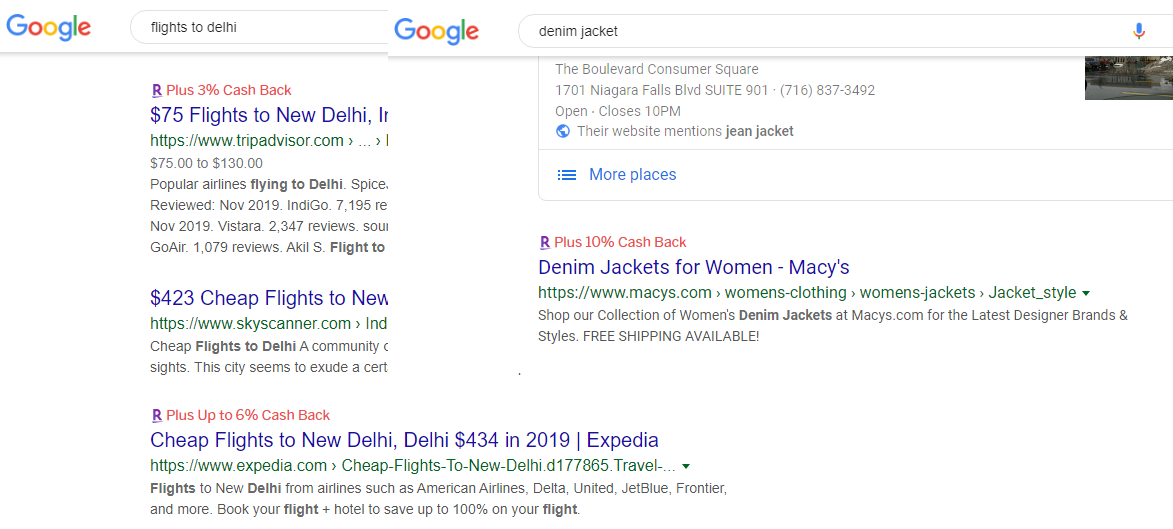
Ebates: Ebates is another app that I have used extensively to save a lot of money on online purchases especially while traveling (booking for hotels or flights). It’s a website/app is owned by Rakuten (one of Japan’s largest eCommerce website), which routes you via their affiliate link and shares most of the affiliate commission back with you. If you have their chrome extension, it prompts you every time if a site has cashback as seen in the image below.
If you are aware of other ways to save money, comment below and I will update the post.
Living in the USA can be costly for a graduate student, but over the years, I have found that we can save some money using different strategies that I am going to share here. It’s always good to be financially smart and aware of the different credit card offers so that you can take advantage of the financial system when needed.
Credit cards: You need a credit card as soon as you join a university to build a credit history. Even if you think you are not responsible enough and might overspend, get a credit card with the lowest limit and use it only for automated bill payments like mobile bills, electricity and other utilities bills. And if you don’t think you can remember to pay your credit card bills, either put it on autopay or mark your calendar within one week of your last day of credit card payment. This will overtime build a credit history with a good payment record and will help you in the future if you apply for other kinds of loans line auto loan, house loan, etc.
Based on your need and credit record, you can choose between different types of credit cards with rewards like
Retail rewards credit cards: you get extra cashback ( 10% or even more) when you purchase from that specific vendor ( like apple credit cards, amazon credit cards, etc)
getting your first card can be tricky, it is like you are fresh out of university and when you apply for a job, it requires experience but to get the experience you need a job.
Most of the credit card companies work similarly, they need a good credit score as well as the length of the credit period. I was rejected for some credit cards even though I had a good credit score stating that the length of my credit history was not sufficient enough.
So getting a new credit card for an international student can be tricky. Also, selecting a proper card can be confusing, so here are my 2 cents to it.
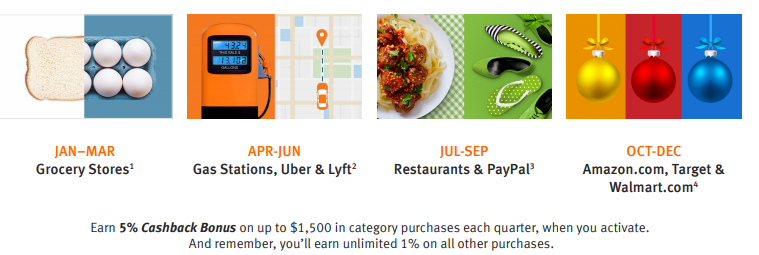
Start with a student credit card as soon as you have your SSN number with you. I applied for Discover IT students credit card and got approved instantly with around 1200$ credit limit which has increased over time. You get 50$ sign up credit bonus and if you perform well in your academics you get an extra 20$ at the end of the first year. I was also able to benefit it’s 5% cashback policy shown in the figure below to get decent cash back on my grocery purchases. Another good news, they matched my first year cashback total giving me an extra 200$ in cashback at the end of the first year.
Once you have your credit card and start building a credit history you can apply for better cards with good sign up rewards. My second card was AMEX delta gold card and I used the card to partially pay my university fee to qualify for the Airmiles (the offer when I signed up was 60000 Airmiles on spending 2000$ in the first three months). That is equivalent to 4 return airfares to JFK from Buffalo with other benefits like first checked-in bag free and 50$ statement credits. It’s an absolute win-win situation, you can partly pay your fees while collecting Airmiles for travel. Although it comes with annual fees of 95$ charged at the end of the first year, you can easily switch to a card with no annual fees and retain your Airmiles at the end of the first year or continue to use the card as it’s totally worth it. You can get an extra 10-15K Airmiles when you use your AMEX delta card to buy tickets to home using KLM-Air France and other partner airlines. The card has no foreign transaction fees, which means you can use it more frequently and save some extra bucks while you are traveling abroad.
If you have a Bank of America account, I would recommend trying their cash rewards or travel rewards cards (linked above). Apart from an exciting signup bonus ( you get 200$ on spending 1000$ in the first three months and no annual fee), you get an extra 10% bonus if you redeem the cashback bonus to your checking account. Which means you get 220$ after you spend 1000$ in the first 3 months of getting the card.
If you want to read more about credit cards, here are interesting blogs to read.
Remember, with great spending limit comes great responsibility. And you must get a card only if you have the ability for controlled spending, protecting your data and paying your credit card bills regularly.
(Note: the author is not a financial advisor and the post is just meant to share his views about responsible credit card usage and contains some affiliate links)
My friend Krishnendu Mukherjee (1st Year Ph.D. student at the University of Notre Dame) has some interesting tips to add to my previous posts. Please go through them before reading this one.
Mailing the prof is a viable option but is not an efficient one (however if it works, this is probably the best indicator of funding). I would first suggest to shortlist the department’s profs based on your area of interest and then send them a quick mail – just in a couple of lines what you did and why you would be an ideal candidate for his/her group. Most often, they are incredibly busy to respond to long emails and hence this is a better strategy. However, at best expect a response between (25% to 50%).
At least a few of the professors (who are interesting) should have vacancy: For example, if you are applying to a particular school and even though there are 3 to 4 people in your field (potential advisors) but none of them has a clear vacancy (this means you have not been able to establish any definite indicator of funding through mailing them, websites, department news or by any other means) while, a similarly ranked or even lower school has at least 2/3 profs taking students then you should apply to the latter. This is very important since a potential P.h.D. student can apply to only a limited number of schools and so you must be sure that at each school in your radar has a certain number of vacancies.
Google Scholar: This is a very underrated tool and a highly useful metric to check if the Prof you are interested in, is actively doing research or not. Many times senior prof’s webpages gives us an impression that they are involved in something but in a few of the cases (by any means not a minority), people have left active research. In the google scholar page, however, you find their recent publications; check if those papers are indeed a product of their lab (often senior profs collaborate with other but no students of there have been doing any of that work). If you find that, yes the prof has published new research with the first author as his/her student, this would provide good confidence that he could take students in the future. Also, you can mail those graduate students too for funding inquiries.
US news international graduate students ratio: (if you happen to be an international student then this is very imp).
Some universities take fewer international students (like UC system, IVY leagues, and most private universities) while others are more open toward them. US news website shows this data and can help you decide whether that university is too competitive or not.
I hope this helps. If you want to get in touch, you can find Krishnendu at:
I would recommend going through it first. To top on the list, I recently discovered that there is another way to discover a potential advisor or an advisor in your field who might be looking to take new PhD students.
In my previous post, I mentioned that a potential advisor would take on a new graduate student only when he has funding or grants available to take new students. Now one way to find that out is via their personal website, where they often advertise new positions or about their funding. But not all Professor or their graduate students actively update their research websites. Sometimes it takes some time for them to update their research group website. Most of the time, the research funding that they might have mentioned on their website might be already allotted to PhD students in their group.
One quick way to find out new potential advisor is to just visit the departmental (your desired major) website of your coveted university. Once on the departmental website, click on their news and updates tab. Getting a research grant is a matter of prestige for universities and department, so often you will find news related to it either on their home page or news and update tab. More often, Professor who has received a funding recently will be willing to take new Ph.D. and postdoc students to carry over that work. Let’s take a look at a few examples.
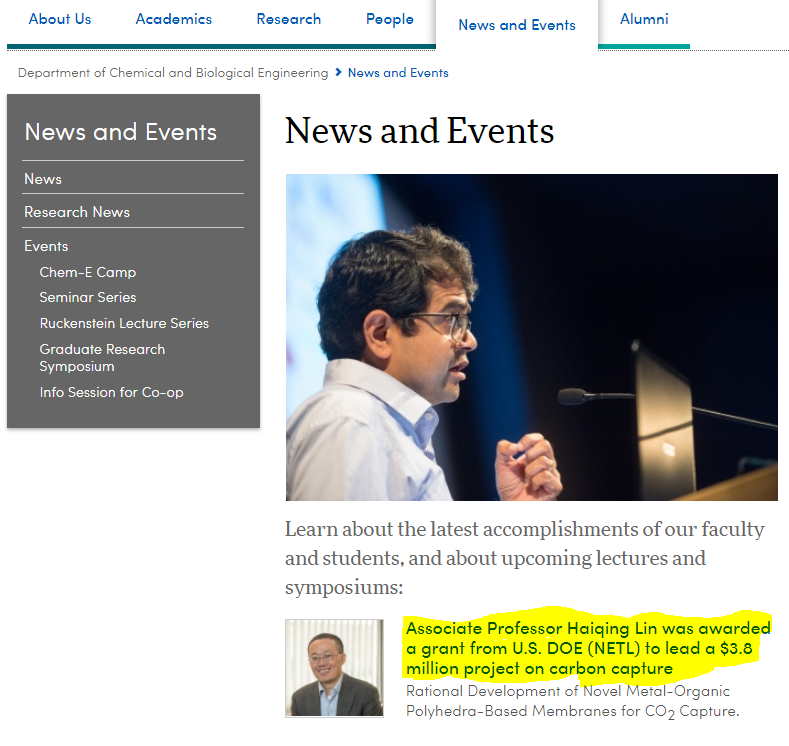
As seen in the figure below, I went to my department website, clicked on the news tab and I can see in the news that Prof. Haiqing Lin has recently received a research grant to develop polymeric membranes for CO2 capture. If I am a prospective student and already interested in working on carbon capture techniques, I would choose this university as compared to another university which hasn’t received any funding to pursue research on such technology.
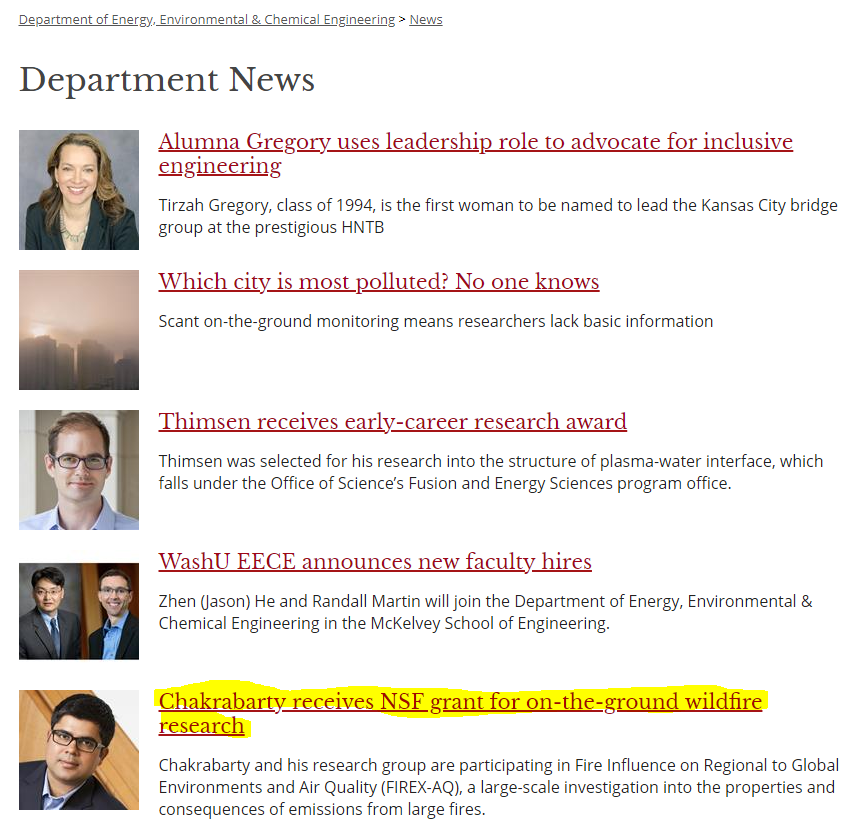
If I click on the news tab, I can see recent news on at least one of their Professor getting NSF grant and the topic for which it was awarded. If the topic interests me, I would try to email him explaining how I can contribute to the project and asking if there is any vacancy.
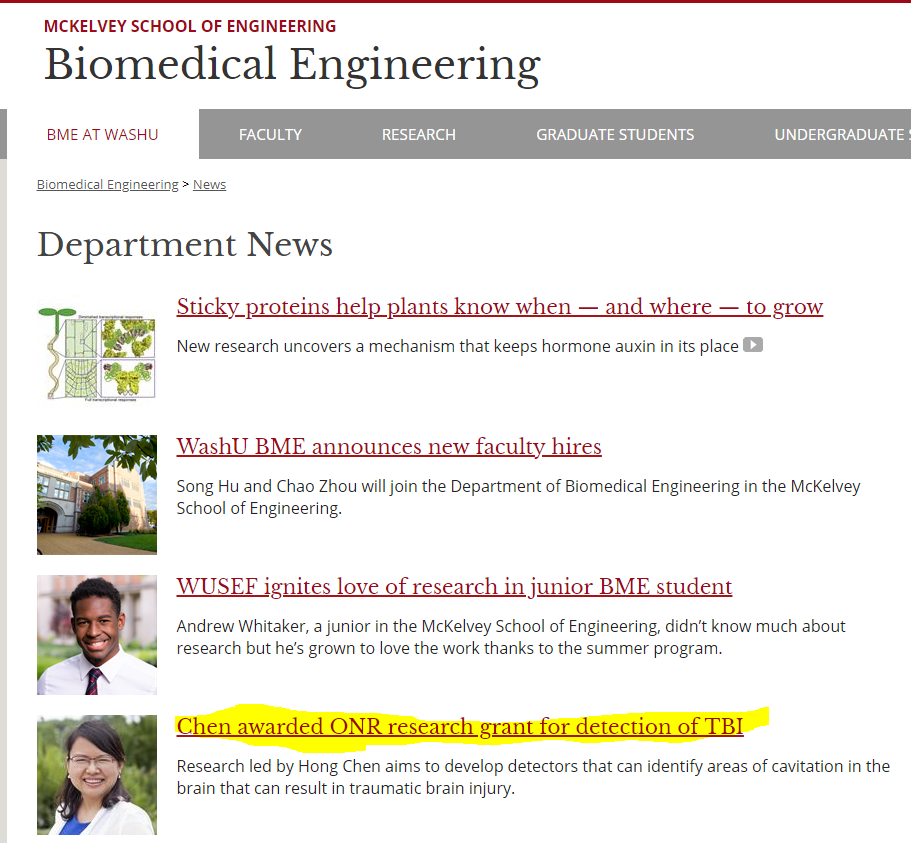
Although the above examples are for chemical engineering major, the same logic applies to other major too as can be seen from the screenshot below of Biomedical Engineering department.
Hence, to conclude, I would say that getting a fully-funded Ph.D. admit and that too with a chance of working on the exact area of interest that one has before joining a university requires careful vetting and extensive research. It is often rewarded with work satisfaction and enhanced performance in the later stages of Ph.D. So do your due diligence before applying for universities.








 Studycentrals