Fully funded masters program in Chemical Engineering related fields

Half the people I speak to on whether they want to move to grad school after their undergraduate degree. Their major dilemma is whether they should leave the soft cushion of a steady income job that they just earned after working hard during their undergraduate degrees or leave all of it and pay hefty college fees again to pursue higher education and venture into unknown. If I ask them the same question but tell them that they can earn a master’s degree without paying a penny, rather they can save some money if they are frugal with their spending habits, the answer tends to be more aligned towards higher education. Now we all know that Ph.D. admit in engineering often comes with a tuition waiver and a generous stipend but finding a fully funded master’s degree is tricky.  Here is a list of few fully funded master’s programs that students can look into.

Erasmus Mundus Programs

Erasmus Mundus is a program funded by the European Commission. Its aims are to encourage mobility (long-term and short-term) of students and staff; to attract the best talents to Europe and; to promote European higher education worldwide.

They offer fully-funded master’s program across various disciplines. Not only they cover your tuition, they also offer a generous stipend to cover your living expenses as well as in some cases, flight fare to reach the program’s center from your home country.

Erasmus Mundus Joint Master Degree Program is an integrated study program and each program often is carried out across various participating universities across Europe.

Let’s take a look at some specific examples.

ERASMUS MUNDUS MASTER NANOSCIENCE AND NANOTECHNOLOGY

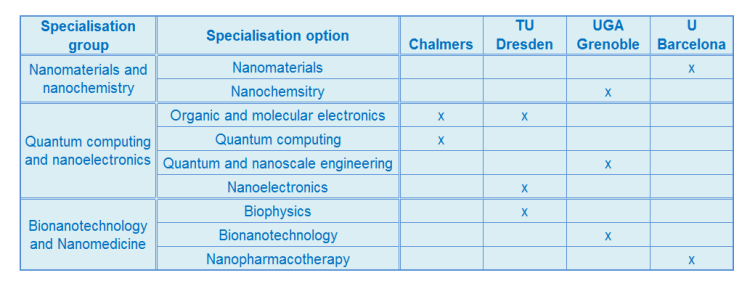
This program is carried in collaboration between 5 partner universities. The course is organized by the KU Leuven (Belgium), Chalmers Tekniska Högskola, Göteborg (Sweden), Technische Universität Dresden (Germany), Université Grenoble Alpes (France) and
Universitat de Barcelona (Spain) with option to pursue different research tracks as shown in the figure below.
 Capture.PNG

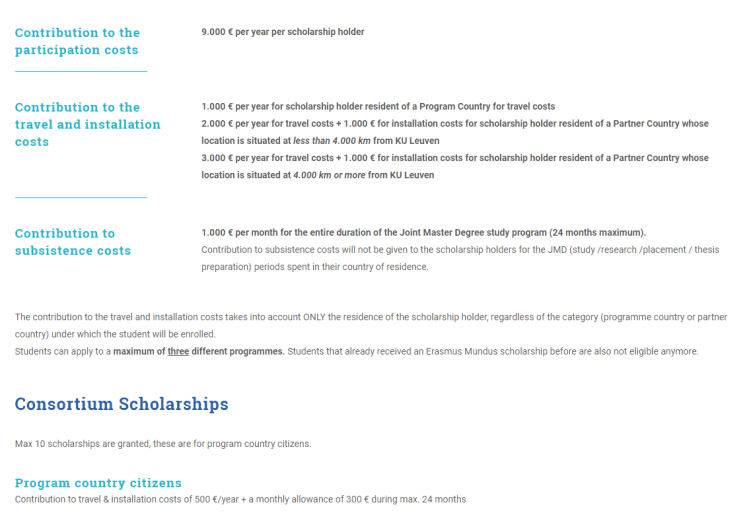
This program comes fully funded scholarship details of which can be found here
2.PNG

Another awesome program that is offered by Erasmus Mundus is

ERASMUS MUNDUS MASTER IN MEMBRANE ENGINEERING FOR A SUSTAINABLE WORLD

The Master in Membrane Engineering for a Sustainable World, EM3E-4SW, offers an advanced educational program related to membrane science and engineering at the interface between materials science and chemical engineering and focused on specific applicative fields. It involves 6 Higher Education Institutions of 5 European countries:

  • Université de Montpellier (France), coordinating organization,
  • Université Toulouse 3 Paul Sabatier (Toulouse, France),
  • University of Chemistry and Technology Prague (Czech Republic),
  • Universidade Nova de Lisboa (Portugal),
  • Universidad de Zaragoza (Spain),
  • University of Twente (Netherlands).

Associated partners are:

  • Università della Calabria (Italy),
  • Catholic University of Leuven (Belgium)

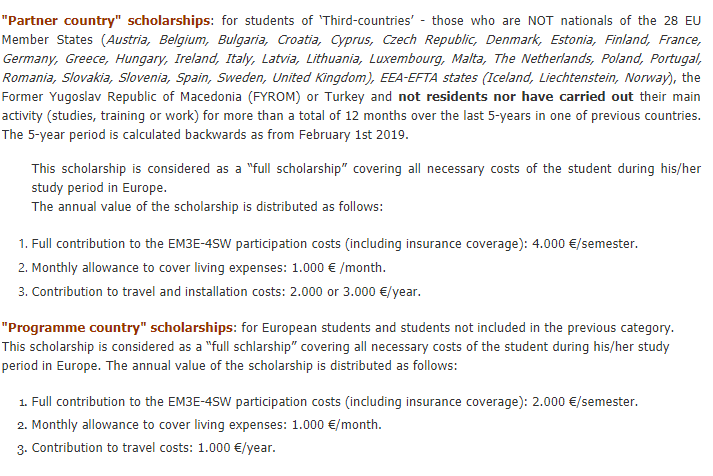
They offer very generous scholarships too which can be seen here
3.PNG

Chemical Nano-Engineering

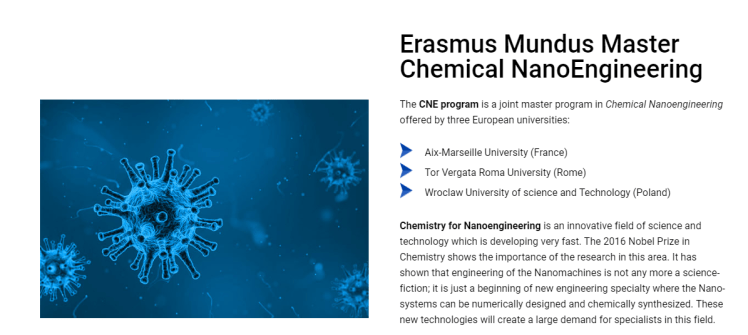
“Chemical Nano-Engineering” is offered by the Consortium of three Universities: Aix-Marseille University in France, Wroclaw University of Science and Technology in Poland and University of Roma Tor Vergata in Italy. These universities have a long experience of common research projects and teaching collaborations in the framework of Erasmus program. They are providing an excellent environment for Nano-Engineering studies and opportunities for students to participate in research projects conducted by world-class researchers. Upon the completion of the two-year cycle, successful students will be awarded a Joint Master degree.
5.PNG

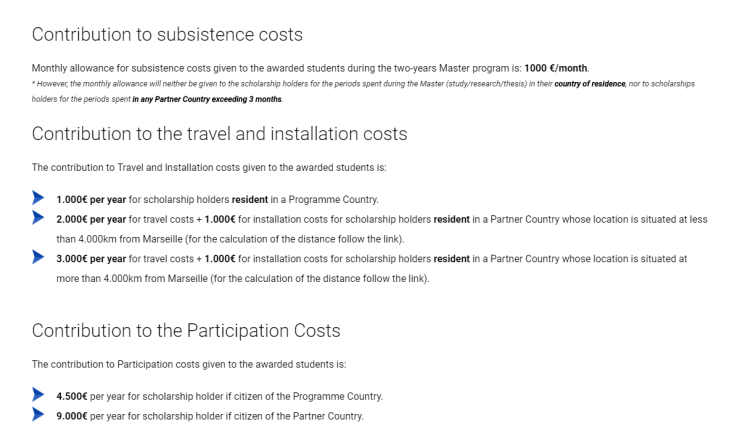
Details about their scholarships can be found here 
6.PNG

MATERIALS FOR ENERGY STORAGE AND CONVERSION

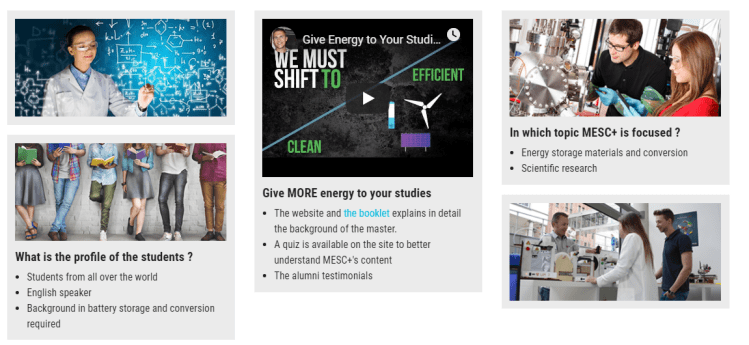
The MESC+ Erasmus Mundus Joint Master Degree is a 2-year programme in Materials Science and Electrochemistry, fully taught in English, involving 5 Universities in 4 European countries (France, Poland, Slovenia and Spain), 2 Universities in USA and Australia, a European Research Institute (ALISTORE), the French Network on Energy Storage (RS2E), the Slovenian National Institute of Chemistry (NIC) and a leading Research Center in Spain (CIC Energigune).

It is run by a number of world-renowned members of Research Laboratories in the field of energy-related materials who work closely together through several European and trans-European projects.
7.PNG

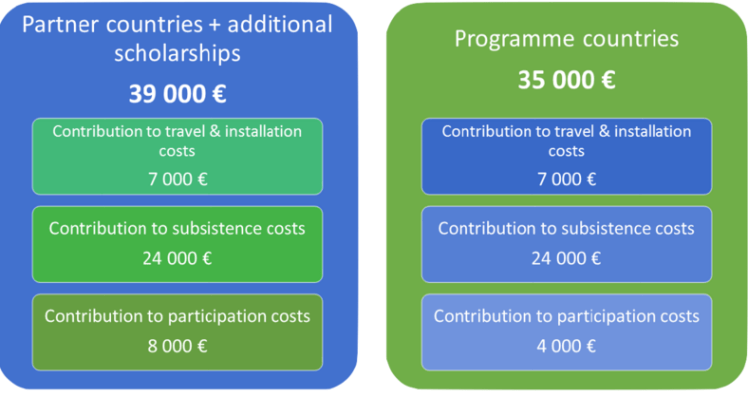
The program again comes with a generous scholarship, the details of which could be found here.
8.PNG

Canadian Universities 

Unlike universities in USA, Canadian universities often fund their master’s student either as Research Assistants/Teaching Assistants although they have to pay for their tuition. for example, Chemical and Applied Engineering department of the University of Toronto offers a generous stipend to their students. Details of which can be found in the image below,
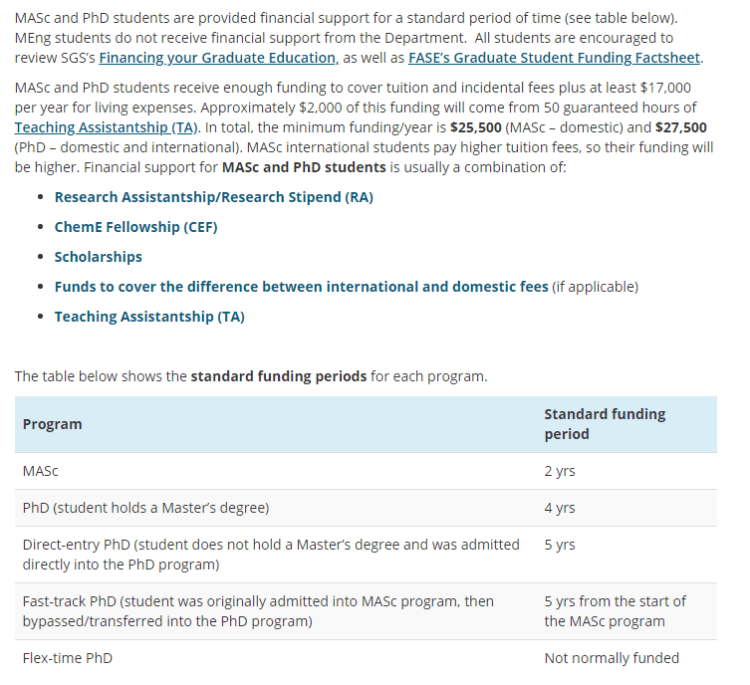
9.PNG

Other universities in Canada offer a similar stipend.


Application Guide for future Ph.D. students

As the application session is coming to its end, I see and hear from many people asking about profile evaluation. I can understand the confusion as I faced them myself probably two years ago. There was much confusion as to where should I apply? How many colleges to apply? Should I email the Professor? etc.

Here I am going to answer the most critical question of all. How should one select the universities to apply to? Now keep in mind that some of the things here are general and applies to all engineering and non-engineering streams.

The most important thing to know here is that many times when people apply, they have a specific area interest in mind. However, it is not necessary that you will end up with a group working in the same field. Here’s how it works.

Once you get an admission offer, the research group you will end up working in often not decided. It becomes clear at the end of the first semester. So when you reach the university, the first semester is spent mostly in coursework. During the end of the first semester, potential advisors will give a presentation in which they will talk about their work and whether or not they will be taking any new Ph.D. students. It depends on their research grant. If they already have a research grant, they will have a clear idea of whether or not they will take a new Ph.D. student. This is the period when most of the decisions on research grants are declared. So either they will explicitly declare they want to take new Ph.D. student or might hold their decisions till they hear back from funding agencies. This brings me to the most important point to look when you are going to apply for Ph.D., Research Grants. 

I always recommend new Ph.D. applicants to ensure that their potential advisor has research grants. It is a good way of increasing your admission chances. Suppose you are a new student interested in working on electrochemical or catalysis related research. Now you have shortlisted few universities and finally, you are confused between two universities X and Y. University X is more popular and highly ranked, but the Professors in both universities have the same impact and research citations. Now if you want to apply to only one out of them, a better option would be to look at their group website for research grants. A typical example would be like the image below.

Capture

I would suggest to go with some with higher research funding and apply to that particular university as it has a higher chance of taking students.

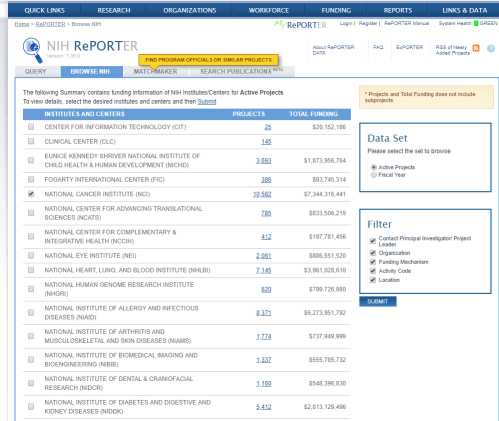
Apart from the existing funding, I would suggest exploring websites like NSF, DOE, and NIH for current funding results and probably select university with higher funding.  Let’s take an example here, suppose you are a biomedical/biochemical student and want to do research on cancer treatment. Here is how you can narrow your selection criteria

  1. Go to NIH RePORTER
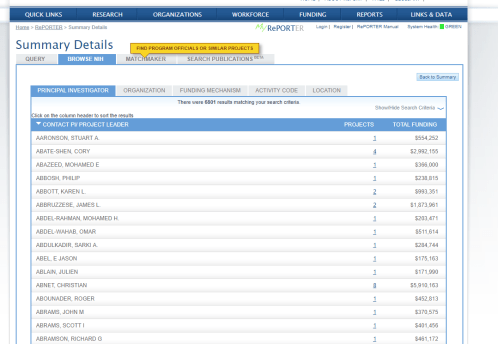
  2. click on browse NIH tabCapture
  3. Click enter and look for your potential advisor and their fundingCapture

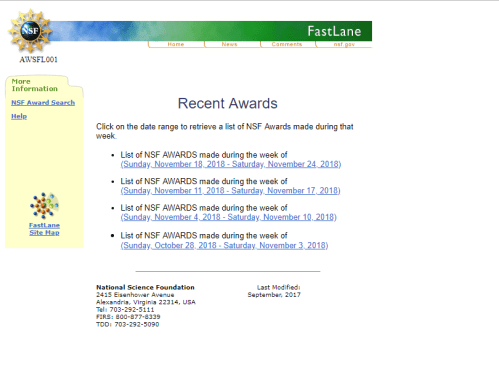
For people working in a field supported by NSF and DOE projects, you can go to their websites and look for department-specific resources. One such example is shown below.

https://www.fastlane.nsf.gov/servlet/A6RecentWeeksCapture

Note: I also recommend writing to Ph.D. students in a particular research group and asking about groups funding scenario and whether they are looking to take new students in the coming application cycle or not. This has a higher chance of response than writing to a prospective professor and asking directly about it.

All the best in your application cycle and let me know if you have any questions. Also, subscribe to my blog to be updated about new posts. Thanks.


Magoosh GRE/TOEFL/GMAT/IELTS/SAT/LSAT Promocodes

GET DISCOUNT ON EVERY COURSE., USE AS FAST AS POSSIBLE, THESE MAY GET EXPIRED SOON

Magoosh TOEFL Codes:

If you need for 1 months account for 29$, then follow these steps:

1) Go to https://toefl.magoosh.com/invite/f5340275k1p176

2) Then select the course you would like to buy and fill out the details.

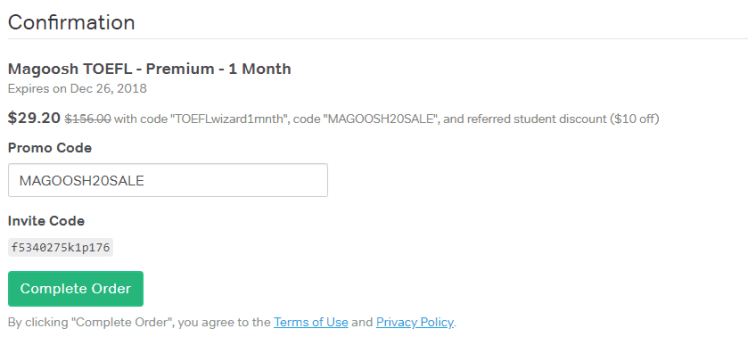
3) The coupon code which you can use is shown in image below Make sure that after the coupon code there is also an invite code thing which says F5340275K1P176.

Capture

Magoosh GRE Codes:

If you need for 6 months account for 99$, then follow these steps:

1) Go to https://gre.magoosh.com/invite/f5340275k1p176

2) Then go to the 6 month subscription and fill out the details.

3) The coupon code which you can use is MAGOOSH20SALE. Make sure that after the coupon code there is also an invite code thing which says F5340275K1P176.

If you need for 3 months account for 109$, then follow these steps:

1) Go to https://gre.magoosh.com/invite/f5340275k1p176

2) Then go to https://gre.magoosh.com/subscribe/3-month-premium and fill out the details.

3) The coupon code which you can use is GCLOVE30. Make sure that after the coupon code there is also an invite code thing which says F5340275K1P176.

4) The 3 month gre magoosh account would be discounted by 30$.

Magoosh GMAT Codes:

If you need a 30$ discount on any of the GMAT Courses, then follow these steps:

1) Go to https://gmat.magoosh.com/invite/f5340275k1p176

2) Then select the course you would like to buy and fill out the details.

3) The coupon code which you can use is GCLOVE30. Make sure that after the coupon code there is also an invite code thing which says F5340275K1P176.

4) The magoosh account would be discounted by 30$.

Magoosh ACT Codes:

If you need a 30$ discount on any of the ACT Courses, then follow these steps:

1) Go to https://act.magoosh.com/invite/f5340275k1p176

2) Then select the course you would like to buy and fill out the details.

3) The coupon code which you can use is GCLOVE30. Make sure that after the coupon code there is also an invite code thing which says F5340275K1P176.

4) The magoosh account would be discounted by 30$.

Magoosh SAT Codes:

If you need a 30$ discount on any of the SAT Courses, then follow these steps:

1) Go to https://sat.magoosh.com/invite/f5340275k1p176

2) Then select the course you would like to buy and fill out the details.

3) The coupon code which you can use is GCLOVE30. Make sure that after the coupon code there is also an invite code thing which says F5340275K1P176.

4) The magoosh account would be discounted by 30$.

Magoosh Praxis Codes:

If you need a 30$ discount on any of the PRAXIS Courses, then follow these steps:

1) Go to https://praxis.magoosh.com/invite/f5340275k1p176

2) Then select the course you would like to buy and fill out the details.

3) The coupon code which you can use is GCLOVE30. Make sure that after the coupon code there is also an invite code thing which says F5340275K1P176.

4) The magoosh account would be discounted by 30$.

Magoosh LSAT Codes:

If you need a 30$ discount on any of the LSAT Courses, then follow these steps:

1) Go to https://lsat.magoosh.com/invite/f5340275k1p176

2) Then select the course you would like to buy and fill out the details.

3) The coupon code which you can use is GCLOVE30. Make sure that after the coupon code there is also an invite code thing which says F5340275K1P176.

4) The magoosh account would be discounted by 30$.

Magoosh MCAT Codes:

If you need a 30$ discount on any of the MCAT Courses, then follow these steps:

1) Go to https://mcat.magoosh.com/invite/f5340275k1p176

2) Then select the course you would like to buy and fill out the details.

3) The coupon code which you can use is GCLOVE30. Make sure that after the coupon code there is also an invite code thing which says F5340275K1P176.

4) The magoosh account would be discounted by 30$.

I hope I helped you. If you have any doubts, comment down below or pm me.


Why I left a good paying job at one of the fortune 500 companies to pursue my PhD degree?

Like millions of engineers around the world, I was really happy having landed my dream job in one of the fortune 500 companies while still in college. My mom was really happy, she had struggled hard to pay my college tuition fees in the past. She probably was in tears on hearing this, finally, her sacrifices have paid off. I was in constant party mood for one week after that and probably didn’t touch any books for the next one month. After all getting job is what every student aims when they enter college, especially people from middle class. Time flies fast, I realized it during the last year of my college. I had been reading about corporate culture, reading reviews about the company I was about to join. There were some negative reviews too, but the optimist in me always focused on the good part of the reviews. There are two sides to everything, right?

At the junction of college to corporate ( pic courtesy : http://ownyourpersonalbrand.com)

My biggest mistake, I guess was thinking that I was ready for this corporate world. During the first one month, I was introduced to every aspect of the company I will be working with and was soon introduced to my manager who will be guiding my transition from college to corporate, from a student to a corporate stooge. The sweetest text I ever received was the notification of my first salary deposit. One week of dining out and parties continued. But as time passed by, I started feeling that I am not meant for this place. Here are the reasons why I felt so

My job was not intellectually satisfying

First of all, my job was not intellectually satisfying. I took this stream of engineering because I was really interested in learning stuff. That is what I was expecting at work too. Now there was a steep learning curve for the first few weeks and I enjoyed absorbing every new information that was thrown at me. But soon after that, there was just monotonous daily work which didn’t require any of the skills I learned while in college.

Secondly, I was not ready to work for someone and hear my boss order me doing mundane jobs daily. Another thing I noticed was petty politics at work. People at work were constantly trying to pull legs of their colleagues in an effort to bring them down.

Third, I noticed that people were not happy. Sometimes corporate start milking their employees so much that they lose all their sense of happiness and become belligerent in stress. I didn’t want to end up like everyone else.

So I started looking for ways out of this corporate world. When I mentioned it to my mom, she was unable to understand why would someone leave such a good job to continue their studies? After all, the purpose of getting a college degree is to get a job. After listening to my reasons, she said that she would support me no matter what. That gave me confidence. I have always wanted to become a scientist and use my knowledge to help society in any ways possible. I guess that was the main reason why I was unhappy at work. It was not what I always dreamt of. So I started applying for Ph.D. programs in the US and was finally lucky to get an admit.

Top 7 podcasts every Ph.D. student should listen 

The word podcast comes from “iPod” and “broadcast” and are series of audio and video files that anyone can download or stream and listen to. There are a plethora of apps available but my favorite are iTunes (on Apple devices), Stitcher and podcast addict. 

I caught up with podcasts last year when I was reading articles of James Altucher who runs his own podcast show ‘The James Altucher Show’. Since then I have been following a lot of podcasts which have helped me not only be motivated but also focussed. I prefer listening to podcasts than music while traveling or doing stuff that requires less cognitive attention.

As a Ph.D. student, people spend a lot of time on screen and or while doing experiments or running simulations. People can utilize this time to listen to podcasts and learn from experiences of people. Also, there are a plenty of podcast series available now, in this post I have listed my favorites. Feel free to comment your favorite below if its missing from the list. My list ranges from academic to entrepreneurial podcasts to even self-help.

1. ACS Publication podcasts: They contain the interview of researchers on their groundbreaking work and challenges faced. I found a real treasure of knowledge and love listening to it wherever something in my field of interest pops up.

2. Ted Talks audio: Well they are indeed “ideas worth spreading” and a must listen.

3. Tim Ferris: The author of “4 Hour Workweek”, Tim Ferris is one of the most influential people when it comes to motivating people. He interviews guests who are exceptional in their fields and basically tries to figure out what led to their success. If you like him, do read his book “Tools of Titan”.

4. ‘The James Altucher Show’: As mentioned above James Altucher was the reason I started listening to podcasts. He is one of the most influential people on LinkedIn. He also maintains a good presence on Quora and some of his answers are worth reading. He also a has a blog and a huge following including me 🙂

5. Mixergy: It’s a podcast where founder Andrew Warner interviews young entrepreneurs. It’s one of the most honest podcast you can find out there and Andrew’s narrative is so good that he makes even their sponsor’s advertisements sound interesting. Why a Ph.D. student should listen to it? Well, I personally feel the problems that many of these entrepreneurs face are analogous to researchers.

6. SmartPassiveIncome: The stipend that Ph.D. students receive is merely sufficient to meet our needs. Some people even have to support their family on that. In such situations, a few extra bucks will never hurt. I firmly believe that every Ph.D. student should start working on a plan to set up a passive income source this could range from making explainer videos of their field on youtube to writing a blog. This podcast interviews people who have successfully built a passive source of income over the years.

7. The Internet of Things: In today’s world, every device can be connected to the internet and can be easily operated with voice command. Stalwarts like Amazon and Google are investing heavily in this technology and their products like Amazon echo and Google home have been fairly successful. So if you are a gadget geek like me you would definitely love this podcast.